Blogs > Simply Fit

Simply Fit, by Cindy Haskin-Popp, will help you make physical activity a part of everyday life. The health benefits of regular exercise and overall daily physical activity will be discussed. Fun, practical and easy-to-follow tips on an exercise program will be shared, as will the most current research. Fitness tips for families and seniors, on fitness centers and on buying proper and affordable equipment will be regularly given. 

Wednesday, April 27, 2011

The Strength of THOR, "God of Thunder"

Paramount Pictures and Marvel Studio's THOR (directed by Kenneth Branagh) hits theaters on May 6, 2011. (Courtesy of Paramount)

Paramount Pictures and Marvel Studios plan to give you a thundering jolt into the mystical world of the Norse gods on May 6, 2011 when their motion picture adaptation of the Marvel comic book superhero “Thor” strikes theaters. Thor (played by Chris Hemsworth) is the mighty, but arrogant, hammer-wielding god of thunder who lives in the mythical realm of Asgard, where magic and science are “one and the same.” Thor falls from the graces of his father, King Odin (played by Anthony Hopkins), after his heedless actions reignite an ancient war with the Frost Giants of the frozen realm of Jotunheim. As a result, Odin strips him of his enchanted hammer (from which Thor acquires his supernatural strength and the ability to control the storms) and casts it, and Thor, down to the lower realm of earth, where Thor is to learn humility as a mere mortal.

This action-packed epic will certainly evoke sheer awe of Thor’s might and have you yearning to possess even just a fraction of his superior strength and power. A fantasy you say? Fortunately, there is a facet of human existence in which magic and science meld into one…..it’s called fitness. That’s right, regular exercise empowers you with optimal health and arms you against chronic diseases. And, proper training can help you develop the god-like physique that Chris Hemsworth acquired for his role as Thor.

Actor Chris Hemsworth trained hard to acquire the muscle mass needed for his role as the god of thunder, Thor. (Courtesy of Paramount)

Hemsworth was able to transform his shape with the help of celebrity trainer Duffy Gaver, a former U.S. Marine Corps Scout Sniper and Navy Seal. Gaver described Hemsworth’s training regimen to me during a recent phone interview. “Building muscle was top-shelf priority,” he said. “If you want to bulk up you gotta get back to body building basics. We bulked Chris by traditional weight lifting.”

Intense, heavy lifting with dumbbells and barbells were often the exercises of choice, but good old-fashioned push-ups and pull-ups and drills in which Hemsworth was “under the gun of the speed clock” were also incorporated. “You do not need expensive equipment or to go to a gym to get fit,” said Gaver. “The military has been getting fit in an open field for years. You just need an open space and something that you can pull yourself up on and/or across the field," he stated. Simply put, to achieve your fitness and health goals, effort is required. “My take on training,” explained Gaver, “is that it is hard work. If you work hard, you will get results.” This is an important point that he raised, because the type of exercise and equipment chosen become irrelevant if you are not willing to give it what it takes to get into shape.

“Chris was ready to go,” stated Gaver. Hemsworth actually exceeded his muscle building goals according to press notes released regarding the production of THOR. Perhaps his attitude helped. To acquire physical prowess, you must have strength of mind. “What you say to yourself is what turns out," Gaver noted. "What you tell yourself is what gets you past and to the next level. If you tell yourself you can’t, then you won’t.” He also explained that you need to “train without thinking about it.” That is, “approach it as you would brushing your teeth,” Gaver suggested. “You don’t think about having to do it [brushing your teeth], you just do it. You should look at training the same way. You have to take for granted that that is what you do, you train. Tell yourself that you will train.....[it is] just what you would do as a part of life.”

Only those who are "worthy" are able to lift the enchanted hammer. (Courtesy of Paramount)

Gaver noted that in addition to weight training, nutrition and rest also played a role in Hemsworth’s muscle mass gains. “You do not get big in the gym. You get big by resting [from the workout]. In the gym you are tearing yourself down. When you eat the right foods for repair, your body will recover and you will get bigger,” he explained. These are noteworthy points. While you sleep, your body repairs and rebuilds itself. And, it can only do that when it has sufficient quantities of the proper nutrients. Gaver stated that Hemsworth met with a nutritionist who added protein to his diet and took away extra starchy carbohydrates.

Another pertinent issue that Gaver addressed is that you need to have fun with your workout. “The best exercise is what is fun to do, because you will do it,” he stated. “It’s not worth bringing the intensity of a workout down a notch just to make a client do the exercises you want him to do. If there is an exercise that he likes, then you incorporate that into the routine. You will get the same result, just a different route,” he explained. Adding variety and attempting new exercises are ways to make working out more enjoyable and can help you develop a desirable physique like Chris Hemsworth did for his role as the titular character Thor.

If you want a taste of what it is like to be the hammer-wielding god of thunder, then let the science of exercise bring you the magic of good health by incorporating the Thor-inspired exercises depicted below into your routine. NOTE: Recommendations are for the general public interested in improving strength to enhance overall health. If you wish to achieve large muscle mass gains, such as Hemsworth did to play Thor, then consider seeking the advice of a certified personal trainer or fitness professional for a personalized program. To find one in your area, visit the website of the American Council on Exercise.

“Hammer” Lift (Wide-Stance Dead Lift) – works the glutes (buttocks), hamstrings (back of thighs), hip adductors, quadriceps (front of thighs) and erector spinae (lower back).
Technique: Assume the squat position with feet wider than shoulder-width apart and pointed out at a slight angle. Grasp the dumbbell, and in one fluid movement, pull back your shoulders while extending your hips and legs to push your torso upward while lifting the weight. Hold the position briefly and then slowly lower your body to the start position. Perform 3 to 4 sets of 8 to 10 repetitions using the heaviest weight that allows you to complete your set without compromising your form.


Single-Arm “Hammer” Swing- works glutes (buttocks), hamstrings (back of thighs), quadriceps (front of thighs), core stabilizers and deltoids (shoulders)
Technique: Flex your knees and hips until your torso is approximately at a 45 degree angle to the ground with the dumbbell between your legs and your arm straight. Forcefully extend the knees and hips to swing the dumbbell up to chest level while assuming an upright position. For the downswing, flex your knees and hips while bringing the dumbbell down through your legs. NOTE: The momentum of the swing comes from the flexion and extension of the hips, with comparatively minimal involvement of the shoulder and arm muscles (which are to be used only to guide the weight). Perform 3 to 4 sets of 8 to 10 repetitions per side using the heaviest weight that allows you to complete your set without compromising your form.


Warrior’s Lunge-works the glutes (buttocks), hamstrings (back of thighs), quadriceps (front of thighs), hip abductors, core (midsection) and obliques (sides of abdomen)
Technique: Hold kettlebell with the horns at chest level. Step back with one leg while flexing the knee of the other and rotating your torso toward the side of the lead leg. Hold briefly and then return to the start position. Perform 3 to 4 sets of 8 to 10 repetitions per side using the heaviest weight that allows you to complete your set without compromising your form.

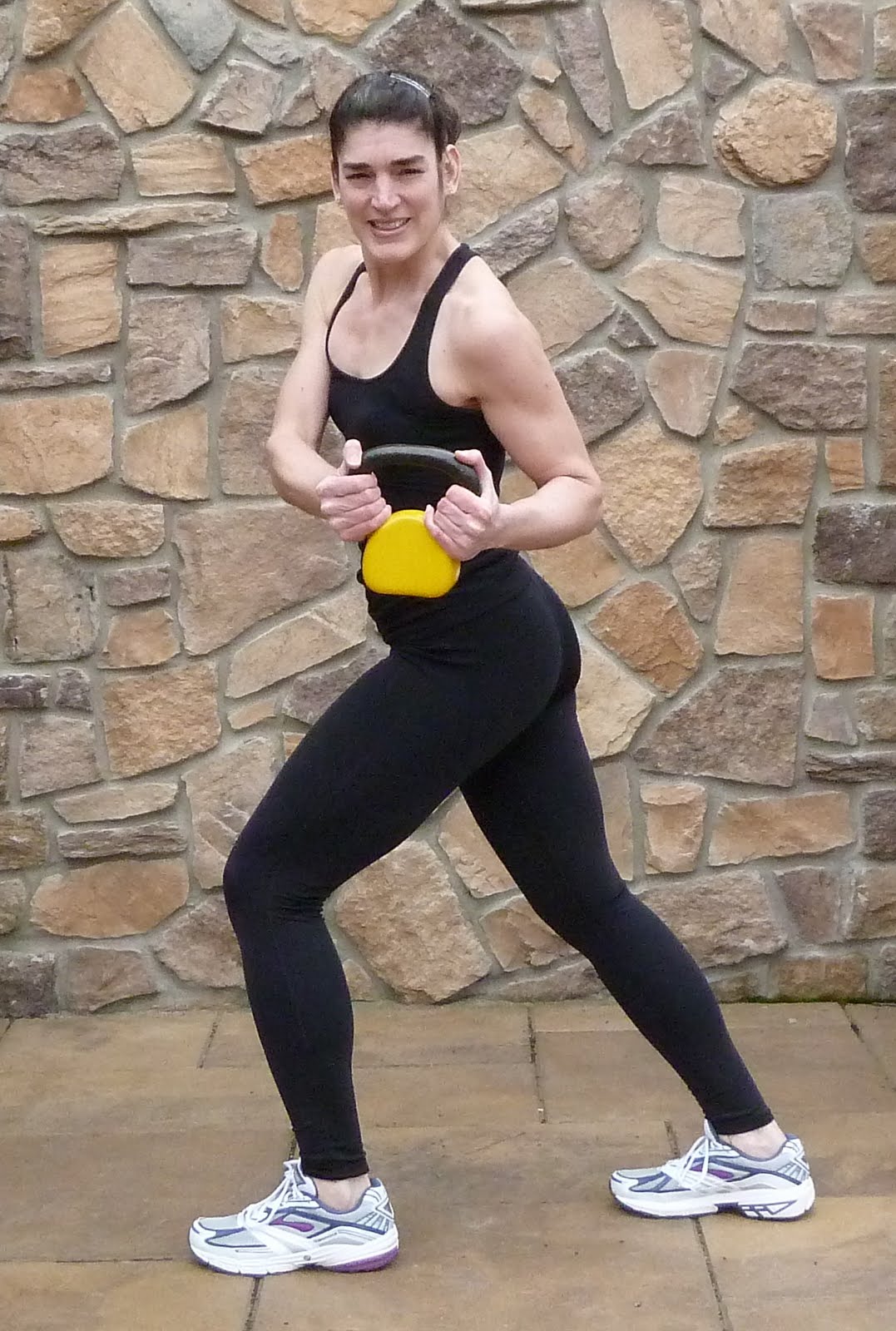
Strike of Thunder (Wood Chopper) – works the core (midsection) and obliques (sides of abdomen)
Technique: Stand with feet shoulder-width apart and knees slightly flexed while holding the dumbbell with both hands. The dumbbell should be held over one shoulder with outstretched arms. Recruit your core muscles to bring the dumbbell down, across your midsection toward the outside of your opposite leg. Hold briefly, then return to starting position. Perform 3 to 4 sets of 8 to 10 repetitions per side using the heaviest weight that allows you to complete your set without compromising your form.


THOR opens in theaters May 6, 2011.


Note: Before beginning an exercise program or increasing the intensity level of a current routine, a physician's approval should be obtained, especially for older adults and those at risk for or who currently have chronic health conditions.

References
Duffy Gaver, Celebrity Personal Trainer; April 19, 2011 Phone Interview.

Paramount Pictures: "THOR" Production Information

Muscle Mechanics: Correct Technique for 65 Resistance Training Exercises, Second Edition; Everett Aaberg; 2006.

Fitness Professional's Guide to Musculoskeletal Anatomy and Human Movement; Lawrence A. Golding, Ph.D., FACSM and Scott M. Golding, M.S.; 2003

Body Sculpting with Kettlebells for Women; Lorna Kleidman; 2009

Labels: , , , , , , , , , , ,

Monday, January 31, 2011

Exercise Order: Cardio or Weight Training First?

Thankfully, there is not a "one size fits all" exercise routine that must be followed. Simply put, your fitness goals dictate the exercise order. This gives you the freedom to focus on the areas of your interest and needs. For the average recreational athlete whose goal is to achieve overall fitness and good health, exercise order is a matter of personal preference and comfort.  Competitive athletes seeking improvements in performance and skill, however, need to pay closer attention to the order in which they train their muscles and cardiovascular system to ensure they are getting the most from their exercise session. Here are a few points to consider when deciding the proper protocol for you:


Improvements in Aerobic Capacity
If your goal is to increase cardiovascular endurance, then aerobic training should occur first in the exercise session. Weight training prior to the aerobic phase could fatigue your muscles. As a result, you may need to either reduce your exercise intensity or prematurely end your aerobic workout, both of which could impair your aerobic capacity in the long run.

Improvements in Muscular Strength and Power
Weight training should occur first in the exercise session when greater muscular strength and power are desired.*  Weight lifting is most effective when your muscles can be challenged at maximum ability.  Performing cardio training first will lower the threshold and limit the amount of weight that you can lift. Furthermore, your ability to maintain proper form while lifting may be compromised if your muscles have been fatigued from aerobic exercise, increasing your risk for injury. Improved muscle recovery is another advantage of weight training prior to aerobic training. The aerobic exercise will help to enhance blood flow and nutrients to the taxed muscles and will facilitate waste removal.

Other Points to Consider
Regardless of whether you do cardio or resistance training first, you should always start with a warm-up. The warm-up should consist of 5 to 10 minutes of mild aerobic activity, such as walking or cycling. A warm-up allows your muscles and cardiorespiratory system to adequately adapt to the increased demands of the training session. A cool-down should also be performed at the end of the exercise session. This will help to facilitate blood flow back to the heart and brain, reducing your risk for untoward events, such as abnormal heart beat or fainting spell.


*Note: during the resistance training phase, exercises to improve muscular power should be performed before exercises to enhance muscular strength.


Before beginning an exercise program or increasing the intensity level of a current routine, a physician's approval should be obtained, especially for older adults and those at risk for or who currently have chronic health conditions. 
 
 
References
American College of Sports Medicine Position Stand: Progression Models in Resistance Training for Healthy Adults
 
American Council on Exercise

Labels: , ,

Sunday, September 5, 2010

Stretch for Strength!

You have heard that stretching can improve flexibility and balance, but increase strength? It can for novice weight lifters according to research conducted by Dr. Joke Kokkonen, professor in the Exercise and Sport Science Department at Brigham Young University-Hawaii.  Dr. Kokkonen and colleagues compared the effects of a combined program of weight training and static stretching to weight training alone on lower-body strength.  Because previous research has shown that stretching activities have been associated with increases in muscle size, Dr. Kokkonen's research team wanted to investigate if a combined training program would have an additive effect, thus resulting in greater strength gains.

The subjects included 32 college-age students (16 women and 16 men) who were matched into pairs based on gender and lower body strength as measured by a knee extension 1 repetition maximum test (i.e., the maximum amount of weight that can be lifted 1 time).  The subjects that were chosen were either physically inactive or did not exercise more than twice per week. One person from each pair was randomly assigned to one of two testing conditions: weight training and static stretching combined or weight training alone. 

The weight training activities for both groups included 3 sets of 6 repetitions for knee extension, knee flexion, and leg press exercises performed 3 days per week for a total of 8 weeks.  Weight load was increased each week.  Those who were in the combined weight training and stretching group performed static stretching activities for 30 minutes at a time twice a week on non-weight training days.  The muscle groups stretched included the quadriceps, hamstrings, hip external and internal rotators, hip adductors and abductors, dorsiflexors and plantarflexors.  Each stretch was performed 3 times and held for 15 seconds followed by a 15-second rest interval.

At the end of the eight weeks, both groups had experienced gains in strength.  However, those in the combined strength training and stretching group showed significantly greater increases in their 1 repetition maximum tests for knee extension, knee flexion, and leg press.  Furthermore, subjects who also performed stretching activities were able to increase workload to a greater degree each week than those who did not stretch.

The investigators conclude that for novice weight trainers who wish to maximize their strength gains, adding a stretching program on nonweight training days can offer some benefit.

Note:  Before beginning an exercise program or increasing the intensity level of a current routine, a physician's approval should be obtained, especially for older adults and those at risk for or who currently have chronic health conditions.

Resource
The Journal of Strength and Conditioning Research; February 2010; pp. 502-506; "Early-Phase Resistance Training Strength Gains in Novice Lifters are Enhanced by Doing Static Stretching"; Kokkonen, J. et al.,.

Labels: , , ,

Sunday, July 18, 2010

Women Should Pump Iron to Manage Weight

If you are looking to keep the pounds off as you age, you will need to add some weight now - by lifting it, that is.  Research findings presented in the July 2010 issue of Medicine & Science in Sports & Exercise reveal that resistance training by postmenopausal women prevents weight gain and improves body composition.  The investigation was a secondary analysis derived from The Bone Estrogen Strength Training (BEST) study which evaluated the effects of weight training on bone mineral density (BMD) in early postmenopausal women.  For the intitial BEST investigation, subjects were first grouped according to treatment with or without hormonal therapy; then, they were randomly assigned to either an exercise or nonexercise group within their respective hormonal therapy category (those on hormonal therapy versus those who were not on hormonal therapy).

In this secondary investigation, researchers set out to examine the effects of resistance training on soft tissue changes and weight management in postmenopausal women.  Subjects included 122 females (mean age 56.3 years, give or take 4.3 years) who were previously sedentary.  After the the first year of intervention, the control subjects were allowed to begin the prescribed exercise regimen, or in other words "crossover."  This created 3 test groups: exercisers - those who were assigned to the exercise group at baseline (n=65); crossovers - those who crossed-over to the exercise program at one year (n=32); and true controls - those women who remained sedentary (n=25).

Exercisers and crossovers participated in 8 core resistance training activities for 2 sets of 8 repetitions each (at 70-80% 1-repetition maximum) on 3 nonconsecutive days/week.  They also engaged in various stretching, balance, and progressive weight bearing activities (e.g., stair stepping with weighted vests).  Exercise frequency and workloads of the various exercises were recorded.  Body weight and fat were measured at baseline and annually for 6 years using anthropometry and dual-energy x-ray absorptiometry.

Researchers found that over the 6-year testing period, weight gain across the 3 testing populations occured in a "stepwise fashion."  That is, individuals who remained sedentary gained the most weight (approximately 2.1 kg) while crossovers gained approximately 0.7 kg and exercisers gained the least at 0.4 kg on average.  Women in the true control group significantly gained weight and total body fat between baseline and year 6.

The investigators conclude that participation in resistance training is a viable option for postmenopausal women to manage body weight.  They purport that it should be one component of a regular comprehensive exercise program to improve overall health and prevent disease.

Source:
Medicine & Science in Sports & Exercise, July 2010, Vol. 42 Issue 7, pp. 1286-1295, "Resistance Training Predicts 6-yr Body Composition Change in Postmenopausal Women," Bea. J.W. et al.,.

Labels: , , , , ,

Monday, January 25, 2010

Side Notes About Exercise And Weight Loss

If you are one of those individuals who struggles to maintain a healthy body weight, despite following a healthy diet and engaging in regular exercise, you are not alone. Weight management can prove to be a challenge for many - hence, the large market for weight loss products. It is easy to become discouraged when your attempt to lose weight is unsuccessful. However, you should not perceive your struggle as a failure. Rather, view the setback as an opportunity for personal growth.

You may need to reevaluate your weight loss plan. If it is not working for you, it may mean that you simply need to change your approach. Maybe you need to alter the timing of your meals or change your mode of exercise. Everyone's physiology is different; therefore, not all diet plans and exercise regimens will have the same effect. Consider the following points below and determine if they would fit into your journey toward better health:
  • Weight Train To Maintain - muscle mass starts to decline around the age of 30, by about 1% per year. This can have a negative impact on your metabolism. Weight training increases your energy expenditure and some research indicates that it mobilizes fat from your abdominal region (decreases visceral fat). Muscle tissue has a greater metabolic demand than fat tissue. To boost your metabolism as you age, ensure you are including at least 2 days of weight training as part of your exercise regimen. Exercises should work the major muscle groups of your body. The average adult should attempt to perform 2-3 sets of 8-12 repetitions per strength training exercise (this may need to be altered based on your personal goals and fitness level).
  • Add Yoga To Your Exercise Routine - A study published in the Journal of the American Dietetic Association found that those individuals who performed yoga were more likely to practice "mindful" eating in which they ate more slowly and stopped eating when they were satiated compared to subjects who did not practice yoga. Yoga goers also had lower BMIs.
  • Watch When You Eat - Although consumption of a post-exercise meal that is rich in carbohydrates is recommended for athletes to maximize their performance, it may not be the best option for the average individual looking to lose weight. A study published in the August 2005 issue of the Journal of Applied Physiology found that the exercise-induced caloric deficit achieved by walking on a treadmill was negated when a carbohydrate-rich supplement was consumed immediately after exercise. Therefore, if weight loss is your goal, you do not want to consume a high carbohydrate meal immediately after exercise.
  • Manage Your Stress - when your body is in a stressed state it releases cortisol. Cortisol plays a role in mobilizing energy for the body in these situations. Chronic stress results in high concentrations of cortisol. High levels of this hormone can result in fat being deposited in the abdomen (visceral fat), subsequently leading to obesity if not controlled. High levels of cortisol can also increase your appetite and cravings for "sugary" and high-fat foods. Over-consumption of these foods can cause weight gain. If stress is a problem for you, try scheduling "down" time, reducing your workload by delegating tasks, and/or engage in stress management techniques (e.g., deep breathing exercises, yoga, etc.,).
Achieving a healthy lifestyle is a process. It requires frequent "checks-and-balances" to stay the course. Setbacks should not be viewed as failures, just indicators that changes are needed.

Resources:
Journal of Applied Physiology, August 2005, pp. 2285-2293, "Improved Insulin Action Following Short-Term Exercise Training: Role of Energy and Carbohydrate Balance," Black, S.E., et al.

Journal of the American Dietetic Association, August 2009, pp. 1439-1444, "Development and Validation of the Mindful Eating Questionnaire." Framson, C. et al.

ACSM's Health & Fitness Journal, September/October 2005, pp. 20-23, "Cortisol Connection: Tips on Managing Stress and Weight," Maglione-Garves, C.A. et al.

Labels: , , , ,